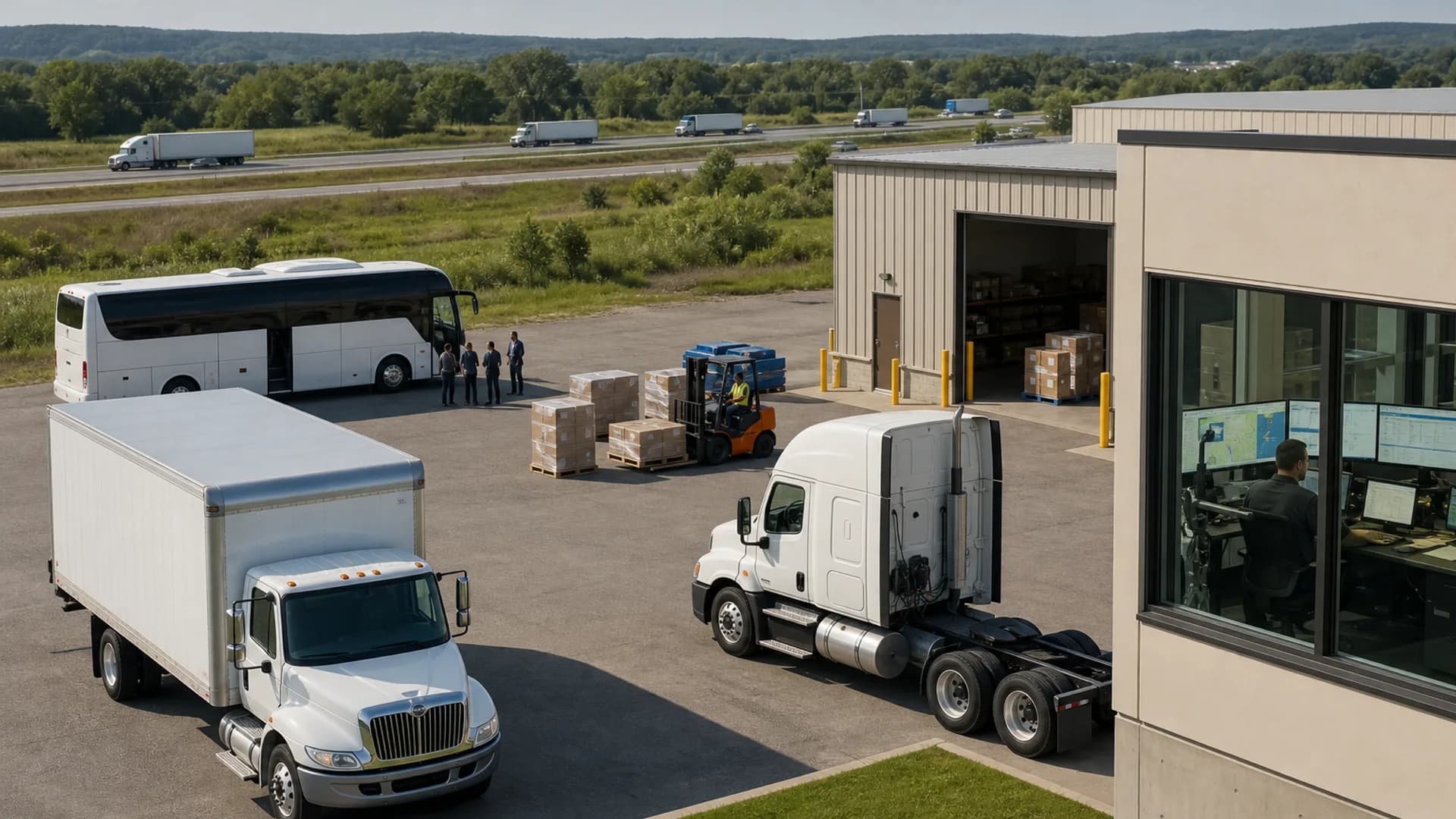
Midwest transportation yard with trucks, cargo, a warehouse, a passenger bus, and a highway in the distance

Transportation Insurance

Protection from point A to point B and everywhere in between

Auto

Primary liability for the units you operate.

Business auto liability is the first layer for a transportation company: and a driver causes. Limits, filings, and whether you run interstate or stay local in Illinois change both the rate and the paperwork.

Learn more →

Tap a point on the scene to learn more

Pin the add-ons that match how you use this coverage

The base transportation policy is the printed form. An endorsement is a taped-on change — adding coverage, taking it away, or renaming who is insured. Optional coverages ride along with the policy. Separate policies sit beside it.

Form names and availability vary by carrier. This is a map of add-ons we commonly shop in Illinois — not a promise that every company offers every item.

Base policy

Transportation policy

Hover an add-on to read it, then click to pin it here — a review list for your next conversation with an advisor.

Send this list to an advisor →We’ll open the contact form for this coverage so an advisor can help you decide which add-ons belong on the policy.

What is an endorsement?

A change taped onto the form

An (sometimes called a rider) amends the base policy. , , , and named-driver are all endorsements. If a certificate or a conversation promised something, it needs to appear as an endorsement — not just in an email.

Hover or tap an add-on to see when it comes up for Illinois families and businesses — then pin a short list to send to an advisor.

The transportation industry is incredibly broad. Moving people and things from one place to another can get complicated. What you transport, where it goes, how it gets there, and other factors are just the tip of the iceberg. That is why you need specialized transportation insurance to take your industry and business-specific risks into consideration.

Specialized transportation insurance that gets to the heart of your business

Imagine a company that transports goods with one truck and only goes a short distance. They have different needs than a company that moves high-value items across the country with a large fleet of trucks. If your business transports people, there are entirely different risks to consider. Interstate, international, and intercontinental transportation each have their own specific needs to consider as well. Your transportation insurance should be tailored to your business so you get the right coverage for any circumstances.

Insurance for your vehicles in your transportation business

Vehicles make up a significant piece of many transportation companies. Having proper business auto insurance is the first step to a comprehensive insurance program. For some organizations, a standard business auto insurance policy might be enough. This provides coverage for physical damage to its own vehicles and for or a driver might be responsible for. For businesses with a large number of vehicles, fleet insurance might be a better option.

You have different insurance needs depending on what you transport

What you transport matters and the type of transportation insurance you need should respond to that risk. For example, trucks carrying high-value items are at higher risk for cargo theft. If you are transporting people, in a chartered bus, limousine, or school bus, your liability insurance needs to cover you in the event of an accident or personal injury. If you are transporting pets or livestock, you will want your policy to reflect that as well.

Managing the logistics of transportation requires insurance protection

There's a lot of planning involved when it comes to transporting goods from one place to another. Transportation logistics provides coverage for times when things do not go as planned. Maybe a shipment is delayed, a connection is missed, or something else happens. You can be held responsible for damages this causes others. Additionally, if part of your business involves warehousing vehicles or goods that belong to someone else, you will need specific coverage for that.

Covering the business end of your transportation business

There are some insurance coverages that are recommended for most businesses. For example, if you have a computer network that holds customer information, insurance is important. Employment practice liability insurance () provides protection if you are accused of discrimination or harassment. Commercial property and insurance are essential to protect your building and property, as well as offering coverage in the event that someone is injured on your property.

Do you need specialized transportation insurance for your business? Contact us to discuss your options for your specific business.

Request a transportation quote to get started.

Frequently Asked Questions

What types of trucking insurance are available in Illinois?
Motor carriers may need primary , physical damage, cargo, bobtail, and non-trucking liability depending on authority, leases, and contracts. Owner-operators and private fleets have different coverage needs.
How do FMCSA and Illinois requirements affect coverage?
Interstate and intrastate operations face filing and limit requirements that vary by cargo, radius, and authority. We help align policies with contracts and regulatory filings.
What is bobtail or non-trucking liability coverage?
These coverages address gaps when a truck is driven without a trailer or for personal use under lease agreements. Without the right , a driver may be uninsured during common scenarios.
Can you provide certificates for brokers and shippers?
Most active clients receive ACORD certificates the same business day. We know Chicagoland logistics contracts often specify cargo, auto, and GL limits.
What is motor truck cargo insurance?
Cargo insurance covers freight you haul for others if it is lost, damaged, or stolen while in your custody, subject to the policy's and . Auto does not replace cargo. Brokers and shippers commonly require a minimum cargo limit before they will tender a load. We match commodities, refrigerated goods, and unattended-truck terms to how you actually run.
What is an MCS-90 endorsement?
The MCS-90 is a federal public- required for many for-hire interstate motor carriers. It is a safety net for the public, not extra insurance for your company: if the insurer pays a claim the policy otherwise excluded, it can seek reimbursement from you. It is not cargo coverage. We place filings alongside the policy so authority and insurance stay aligned.
What insurance do owner-operators typically need?
Owner-operators often need primary auto or non-trucking liability depending on the lease, physical damage on a financed truck, occupational accident or , and cargo if they haul under their own authority. Trailer interchange and bobtail gaps are common. We read the motor-carrier contract instead of selling a generic trucking package.
What is trailer interchange coverage?
Trailer interchange covers physical damage to a trailer you do not own but are responsible for under an interchange agreement, such as a dropped trailer at a Chicago-area terminal. Non-owned trailer is a different question. Without interchange, a damaged bobtail-connected trailer can become an out-of-pocket loss. We add it when your leases require it.
What is the difference between trucking insurance and commercial auto?
Commercial auto fits many local service fleets. Trucking or motor-carrier programs add cargo, federal or state filings, radius and commodity , and such as MCS-90 or trailer interchange. A contractor's pickup and a for-hire tractor are not the same risk. We place Illinois operators in the form that matches authority, not the cheapest auto quote.
Why use an independent agency for Transportation Insurance?
As an in Roselle, we compare Transportation Insurance options from multiple carriers instead of a single company menu. That helps Illinois clients find coverage that fits their risks, contracts, and budget—with local follow-up when questions or claims come up.

Endorsements and add-ons

The same transportation policy add-ons from the explorer above, listed out. Form names and availability vary by carrier.

Contingent cargo / broker liability

Endorsement

When you arrange loads rather than haul them yourself.

Freight brokers need contingent cargo and sometimes contingent auto — because the hired carrier’s insurance can fail. That is not motor truck cargo for your own trucks. Mixing broker and carrier operations on one form is how people get surprised.

Hired auto physical damage

Endorsement

Collision and comprehensive on a rented or borrowed truck.

does not repair the Penske you rented. Hired physical damage (or the rental company’s waiver) does. We compare the limit to the rental fleet you actually use.

MCS-90

Endorsement

Public liability endorsement required for many motor carriers.

MCS-90 supports federal (and some Illinois) financial-responsibility filings. It is a public safety net, not extra cargo. Radius, GVW, and interstate vs intrastate change whether you need it. We do not treat it as optional once you are a motor carrier.

Motor truck cargo

Endorsement

The freight in your custody — not the truck itself.

Cargo is a separate coverage from commercial auto physical damage. Limits, commodities, and theft warranties (unattended truck, kingpin locks) decide claims. Refrigerated loads need a reefer-breakdown conversation on top of cargo.

Non-trucking (bobtail)

Endorsement

Liability when operating a tractor without a trailer, off dispatch.

Owner-operators often carry non-trucking for bobtail movements when not under the motor carrier’s dispatch. It is not a full commercial auto replacement and it does not cover hauling a load. Wrongly assuming the motor carrier’s policy follows the tractor is a common gap.

Radius / territory

Endorsement

The geographic box the auto coverage is priced and limited to.

A 50-mile radius policy that regularly runs to Indiana or Wisconsin is a misclassified risk. Radius and territory symbols should match dispatch. after a claim in another state is a bad time to discover the box you bought.

Reefer breakdown

Endorsement

Cargo spoilage when the refrigeration unit fails.

Cargo forms often exclude spoilage unless the reefer unit itself has a sudden mechanical breakdown — and even then, maintenance records matter. A reefer-breakdown is how grocers and food haulers close that hole. A driver leaving the unit off is a different story.

Scheduled trailer physical damage

Optional coverage

Your owned trailers, listed and valued.

Owned trailers need to be scheduled for physical damage. A tractor policy does not silently cover a $60,000 reefer trailer in the yard. vs matters after a hailstorm in the lot.

Trailer interchange

Endorsement

Physical damage for trailers you pull but do not own.

Interchange agreements make you responsible for the other company’s trailer. Trailer interchange is the that insures that trailer while in your possession. It is not cargo and it is not your scheduled trailer’s physical damage.

Uninsured / underinsured motorist

Optional coverage

Optional on commercial auto — still worth a hard look.

Commercial auto is often rejected to save . A serious crash with an uninsured motorist still injures your driver. Illinois personal-auto habits do not automatically carry over. We show the rejected-coverage form rather than burying it.

Ready for a Quote?

Speak with a local advisor who understands your coverage needs.

  • Geico insurance quotes through Hausman-Kunkel Insurance in Roselle, IL
  • AAA insurance quotes through Hausman-Kunkel Insurance in Roselle, IL
  • Hartford insurance quotes through Hausman-Kunkel Insurance in Roselle, IL
  • Progressive insurance quotes through Hausman-Kunkel Insurance in Roselle, IL
  • Liberty Mutual insurance quotes through Hausman-Kunkel Insurance in Roselle, IL
  • Travelers insurance quotes through Hausman-Kunkel Insurance in Roselle, IL
  • Safeco insurance quotes through Hausman-Kunkel Insurance in Roselle, IL

Contact Hausman-Kunkel Insurance

As an independent agency, we are here to help you find the right coverage.

Please do not include sensitive, private information in this area.

Get a Quote

It only takes a minute to get started.

  • Fill out the form, we'll be in touch.
  • Go over your options with an agent.
  • Get the coverage you need.

Would you rather discuss this in person? Get in touch with an agent today!

Contact Us