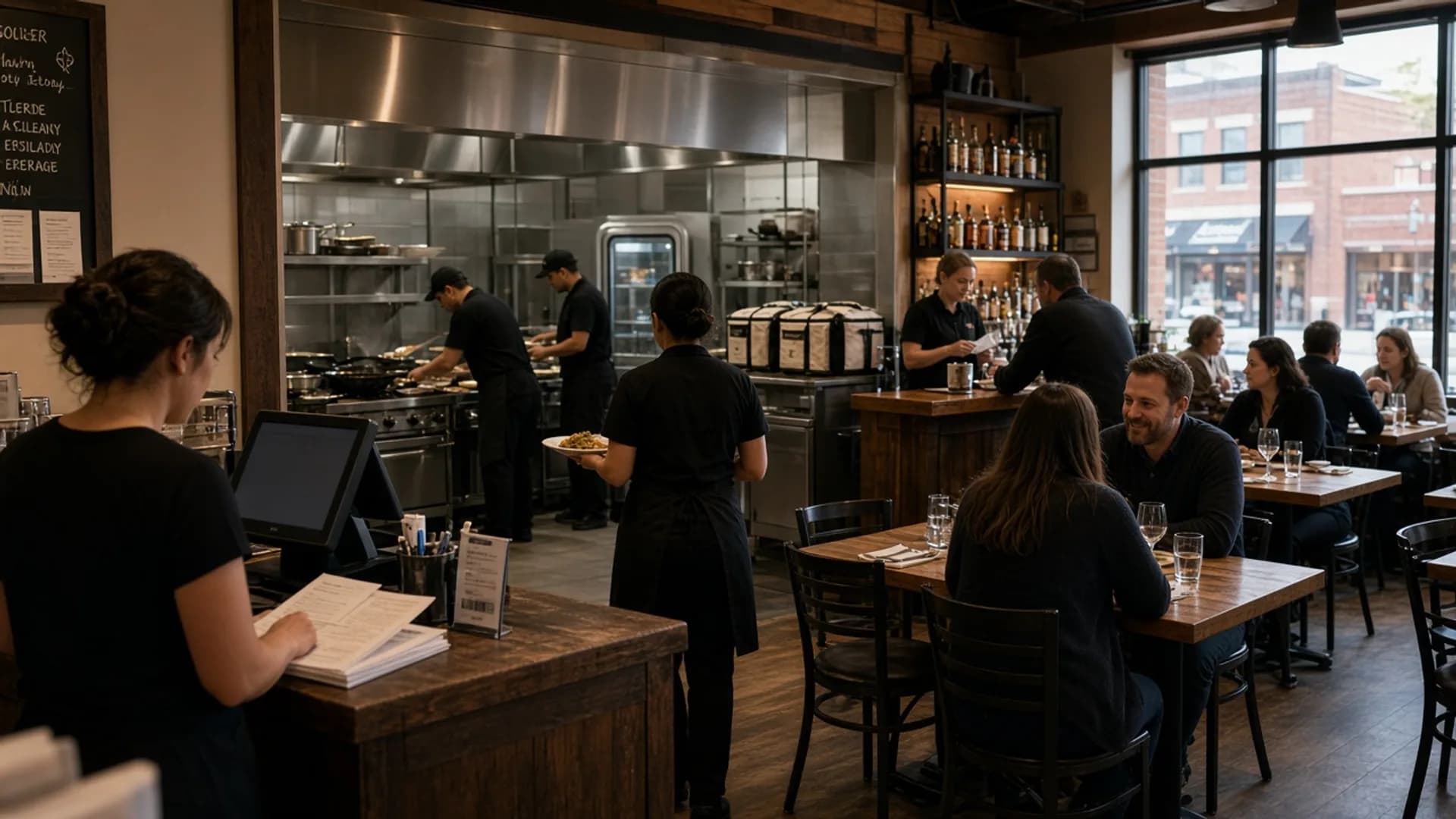
Chicagoland restaurant dining room with an open kitchen, host stand, bar, walk-in, and guests at tables

Restaurant Insurance

Rest easy knowing you have the proper coverage

Patron injury in the dining room — slips, spills, and falls.

Restaurant general liability responds when a guest is hurt on the premises — a wet floor, a hot plate, or a fall on the way to the restroom. Illinois restaurants start here, then layer kitchen, liquor, and delivery exposures a storefront office policy never contemplated.

Learn more →

Tap a point on the scene to learn more

Pin the add-ons that match how you use this coverage

The base restaurant policy is the printed form. An endorsement is a taped-on change — adding coverage, taking it away, or renaming who is insured. Optional coverages ride along with the policy. Separate policies sit beside it.

Form names and availability vary by carrier. This is a map of add-ons we commonly shop in Illinois — not a promise that every company offers every item.

Base policy

Restaurant policy

Hover an add-on to read it, then click to pin it here — a review list for your next conversation with an advisor.

Send this list to an advisor →We’ll open the contact form for this coverage so an advisor can help you decide which add-ons belong on the policy.

What is an endorsement?

A change taped onto the form

An (sometimes called a rider) amends the base policy. , , , and named-driver are all endorsements. If a certificate or a conversation promised something, it needs to appear as an endorsement — not just in an email.

Hover or tap an add-on to see when it comes up for Illinois families and businesses — then pin a short list to send to an advisor.

Restaurants carry a very unique set of risks. We can customize a menu of insurance solutions to meet your specific needs. Reviewing the options and developing a plan for restaurant insurance coverage is the perfect recipe.

Insurance that works as hard for your business as you do

As a restaurant owner, you know the amount of work it takes to run your business on a day-to-day basis. You might also know the statistics about how tough it is to survive and thrive in the business. But did you know that getting adequate insurance at least gives you a fighting chance by mitigating some of the risks involved in the food industry?

What every restaurant owner should know about restaurant insurance

On top of traditional business insurance, it is well worth considering a custom-built restaurant insurance policy, as this will not only make life simpler but may even cover some risks you hadn't considered. There are unique aspects of running a restaurant that make it different than other types of businesses, which means different coverage is required.

Protect the property your restaurant is on

One of the most important parts of most restaurants is the property it is located on. For that reason, most restaurants will usually cover risks to property, such as the building and equipment, along with to customers and staff.

The complexities of restaurant insurance

Aside from property liability coverage, there's an important difference to note between (such as a customer slipping on a spilled drink) and (such as a bout of food poisoning from bad food or inadequate preparation). General liability primarily covers patrons who are injured on your property, as well as , and can protect you from potential lawsuits. Professional liability, on the other hand, protects your restaurant if someone gets sick from spoiled food products.

The hidden risks of running a restaurant

Other elements that are easy to overlook include the risks of fraud and data theft that come with handling cash and card payments, the risks of spoiled food you have to throw away if there's a power outage or refrigeration failure, and the risk of lost business if you close for repairs after a fire.

Protect your restaurant by contacting us today.

Request a restaurant quote to get started.

Frequently Asked Questions

What does Restaurant Insurance typically cover?
Policies often combine property, , liquor where applicable, and business interruption. Kitchen equipment, food spoilage, and customer injury exposures should be reviewed together.
Do Illinois restaurants need liquor liability coverage?
If you serve alcohol, liquor is usually essential and may be required by landlords or liquor license rules. It addresses claims tied to alcohol service beyond standard .
How does business interruption coverage help food businesses?
A fire, equipment failure, or covered property loss can shut down service for days or weeks. Business interruption may help replace lost income and ongoing expenses while you recover.
Can you provide certificates for landlords and vendors?
Most active clients receive ACORD certificates the same business day. We align limits with lease requirements common in Chicagoland commercial spaces.
Does restaurant insurance cover food poisoning?
Products and food-borne illness coverage — not ordinary premises — is how a claim that someone got sick from a meal is meant to be handled. General liability covers slips and falls in the dining room. A documented outbreak can also involve extra expense, medical testing, and lost income through a food-contamination . Kitchen procedures still matter; insurance is not a health-department substitute. We review products, contamination, and liquor together for Illinois restaurants.
Does restaurant insurance cover food spoilage after a power outage?
Spoilage coverage can pay for food you have to throw away after a refrigeration or power failure, subject to the limit and maintenance warranties. Ordinary property insurance treats a dead walk-in as equipment failure, not a fire. Pair spoilage with equipment breakdown so a failed compressor is not an out-of-pocket weekend. We set limits to how much inventory actually sits in Chicagoland walk-ins in July.
Do Illinois restaurants need workers compensation?
If you have employees, Illinois generally requires . Kitchen cuts, burns, and wet-floor slips are restaurant-frequency injuries. 1099 delivery drivers versus W-2 staff is a classification question, not a way to skip the coverage. Landlords and liquor licenses often still ask for a certificate. We check payroll class codes before you hire the first cook.
Does restaurant insurance cover delivery drivers?
does not follow a catering drop or a manager running to Sysco in a personal car. Hired and is the usual on a restaurant package. A true delivery fleet belongs on commercial auto. Personal auto policies often exclude business use. We match the endorsement — or the auto policy — to how food actually leaves the building.
What is the difference between a BOP and a restaurant package?
A packages property and for many small storefronts. Restaurant programs add kitchen, spoilage, liquor, and food-borne-illness conversations a generic BOP may underwrite poorly or exclude. Full-service rooms with a bar, delivery, or a grease-heavy hood usually belong in a restaurant form, not an office BOP. We compare both for Illinois operators instead of forcing a one-size policy.
Why use an independent agency for Restaurant Insurance?
As an in Roselle, we compare Restaurant Insurance options from multiple carriers instead of a single company menu. That helps Illinois clients find coverage that fits their risks, contracts, and budget—with local follow-up when questions or claims come up.

Endorsements and add-ons

The same restaurant policy add-ons from the explorer above, listed out. Form names and availability vary by carrier.

Assault and battery (limited buyback)

Endorsement

Restores some liability the form otherwise excludes.

Many restaurant forms exclude assault and battery. A limited buyback can restore coverage with a sublimit, often with security warranties. Full-service rooms with a bar still see parking-lot and late-night claims even if they are not nightclubs.

Cyber liability

Separate policy

POS, online ordering, and payment cards.

POS terminals and online ordering hold guest data. Cyber is almost always a separate policy or a dedicated with its own application. A ransomware event on the register is not a fire claim.

Employee dishonesty / crime

Endorsement

Theft of money, liquor, or inventory by an employee.

Cash drawers, liquor, and food inventory walk out the door more often than break-ins. Employee dishonesty is a crime (or a crime policy), not . Limits should reflect how much cash and high-value inventory sit on site.

Equipment breakdown

Endorsement

Sudden mechanical or electrical failure of hoods, coolers, and HVAC.

Kitchen equipment fails in ways property insurance treats as mechanical breakdown, not a . Equipment breakdown (boiler and machinery) is the buyback for a compressor, a hood fan, or a sudden electrical failure. Pair it with spoilage if the cooler is the business.

Food contamination

Endorsement

Limited extra expense after a food-borne illness event.

Food contamination coverage can help with lost income, extra advertising, and medical testing after a documented contamination incident. It is not a substitute for kitchen procedures or health-department compliance. Carriers underwrite it tightly, and it is not the same as premises for a slip-and-fall.

Hired and non-owned auto

Endorsement

Liability for catering runs and employees in personal cars.

Catering drops, Sysco runs, and managers in personal cars create auto the GL form does not cover. Hired and is the usual on a or restaurant package. A true delivery fleet may need commercial auto instead.

Liquor liability

Separate policy

Dram-shop coverage — usually its own policy, not a GL extra.

typically excludes liquor. Restaurants that sell drinks need liquor , often a separate policy. Host liquor for incidental serving is not the same as a bar program. Illinois dram-shop exposure is the reason we split this out.

Learn more →

Ordinance or law

Endorsement

Code upgrades after a partial loss to an older restaurant building.

Older storefronts and converted spaces often need sprinkler, accessibility, or electrical upgrades after a fire. coverage is how you pay for that increment. The base building limit rebuilds what was there, not what the village now requires for a commercial kitchen.

Spoilage

Endorsement

Food loss after a refrigeration or power failure.

A walk-in that dies on a July weekend is a spoilage claim, not a typical property fire claim. Spoilage set a limit and often require working refrigeration maintenance. Independent restaurants in the western suburbs feel this as often as any other kitchen loss.

Ready for a Quote?

Speak with a local advisor who understands your coverage needs.

  • Geico insurance quotes through Hausman-Kunkel Insurance in Roselle, IL
  • AAA insurance quotes through Hausman-Kunkel Insurance in Roselle, IL
  • Hartford insurance quotes through Hausman-Kunkel Insurance in Roselle, IL
  • Progressive insurance quotes through Hausman-Kunkel Insurance in Roselle, IL
  • Liberty Mutual insurance quotes through Hausman-Kunkel Insurance in Roselle, IL
  • Travelers insurance quotes through Hausman-Kunkel Insurance in Roselle, IL
  • Safeco insurance quotes through Hausman-Kunkel Insurance in Roselle, IL

Contact Hausman-Kunkel Insurance

As an independent agency, we are here to help you find the right coverage.

Please do not include sensitive, private information in this area.

Get a Quote

It only takes a minute to get started.

  • Fill out the form, we'll be in touch.
  • Go over your options with an agent.
  • Get the coverage you need.

Would you rather discuss this in person? Get in touch with an agent today!

Contact Us